Webinar recording
AI for Print: Turning Innovation into Orders & Profit
Recorded live on 28 October 2026. Kelvin walks through the Vpress AI modules, Brand Assist, Design Assist and Order Assist, and the print bottlenecks each one is built for. Craig joins him for the questions.
- Recorded
- 28 October 2026
- Length
- 56 minutes
- Speakers
- Craig Smith and Kelvin Bell
The webinar in five points
- 1
Real profit is lost before the press, in the communication and admin before a job is scheduled. AI can add value by removing those bottlenecks.
- 2
AI used surgically, not as a complete fix: Brand Assist, Design Assist and Order Assist. Use them all, or pick the ones you need.
- 3
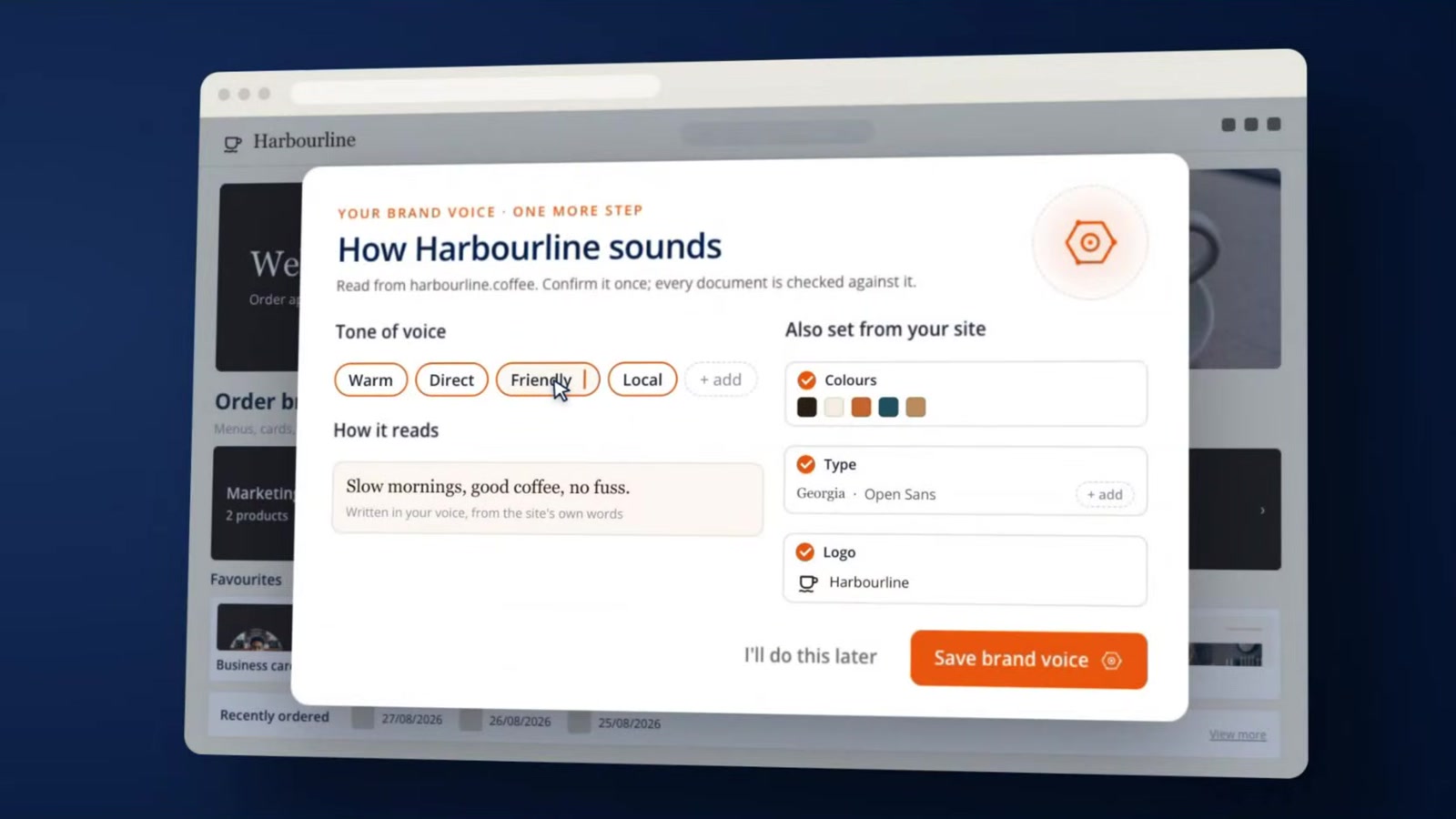
Brand Assist reads a client's website, its colours, fonts, images and tone, and sets up their storefront. Everything can be overridden.
- 4
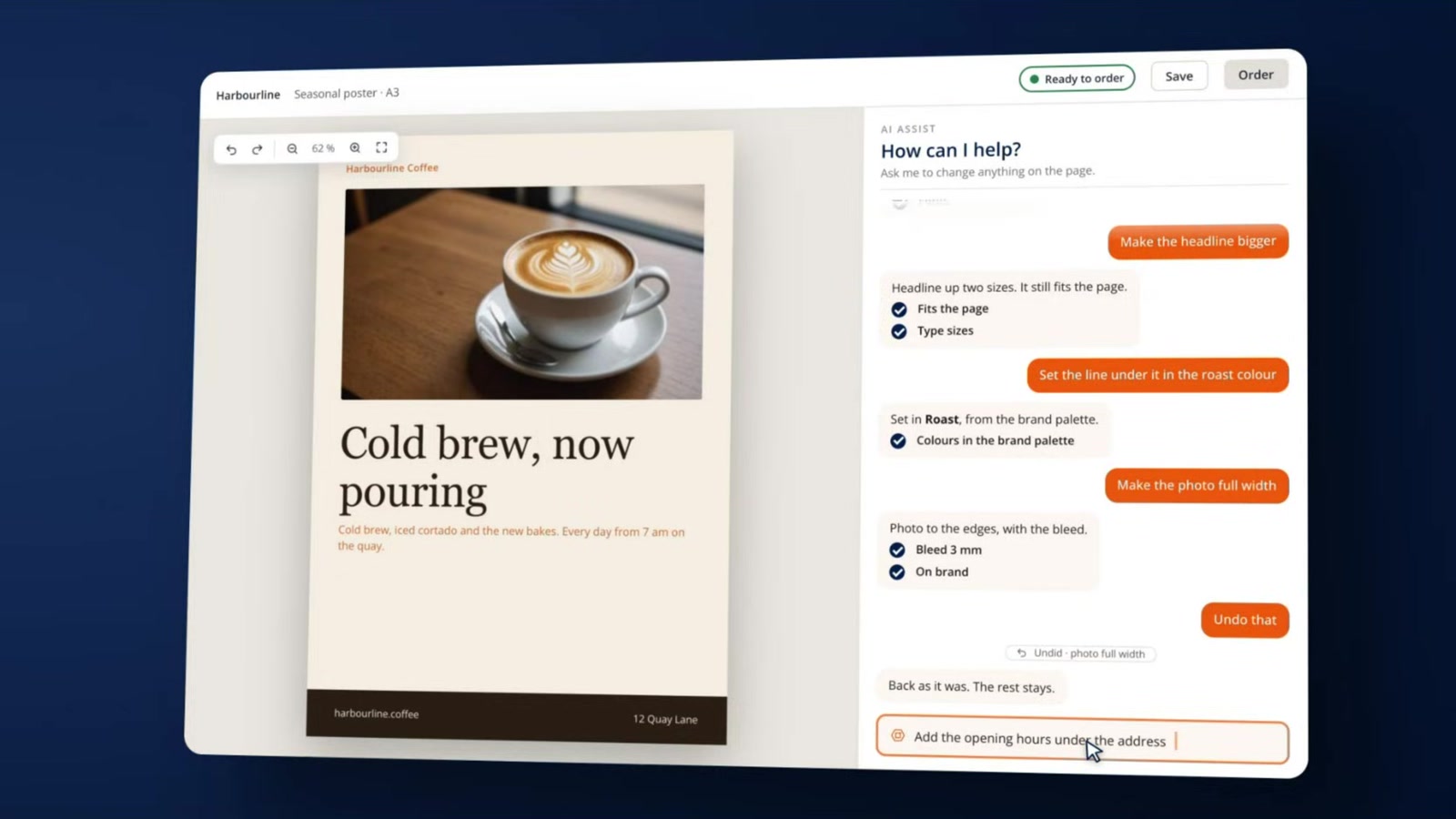
Design Assist and Order Assist let buyers edit and order in plain language, inside the brand and production guardrails, so the order can go straight to production.
- 5
Many corporates want to be able to switch AI off. Vpress AI comes with a kill switch as standard.
Chapters
Transcript
Cleaned from the live captions. Timestamps play the video from that moment. Hesitations and asides removed, product names corrected, and questions shown without the names of the people who asked. Nothing added.
Welcome, and who Vpress is
KelvinMy name is Kelvin Bell, I'm the sales director at Vpress. We had over 90 people register for this event. I've got one slide on updates people have asked for on the Coreprint web-to-print system, then a brief look at the UK print landscape and the US market, and then the nitty-gritty of Vpress AI and what we've done. At the end I'll be joined by Craig, whose team is responsible for AI within the Vpress web-to-print product.
KelvinFor those of you who don't know, Vpress is a web-to-print company. We're based in the UK, and we're in our 25th year, which we're super proud of. We operate with no borrowings, debt or VC. We're truly a bootstrapped company: we finance our own development and our own growth. It's a journey we chose many years ago, and it means we're much more robust and can support our customers' needs and expectations much further.
KelvinEverything is our own software. I'm the sales guy, and we're joined by Craig, who looks after our development, so between us we can probably answer any questions you have at the end. We develop it in-house and we support it in-house, and that puts us in a really strong position in the marketplace.
KelvinWe're based in Cheltenham, Gloucestershire, we operate out of Sydney, Australia, and more recently we've opened up in the US. A lot of our growth now is in the US.
KelvinMost companies coming to us are already using web-to-print, and they move across to us for a different web-to-print experience. We believe automation pays for itself post-sale: once you start automating those jobs, you can save 10, 20, 30% of the cost of producing items in production, not the sell price. Our model is based around supporting you, so as you grow your business, our model is intrinsically linked to that. And that's before we even get into AI.
The second quarter update
KelvinOur second quarter update. We've launched a free app for Enfocus Switch. It's out-of-the-box integration: you can download it from the Enfocus Appstore and start using it straight away as a Coreprint customer. We're absolutely committed to driving workflow efficiency and automation for all of our customers, and Switch is a widely used application, so we've made sure we can integrate with it without cost, out of the box.
KelvinWe've updated the shipping aggregation integration. We have to rely on a third party there, the same as with direct mail, and we now have dynamic pricing based on shipping options, from within the order.
KelvinWe've updated the Shopify app. Shopify is very much becoming dominant in the B2C market, and we can embed our technology within it. There's a charge to configure it, because there's work required, but it's very reasonable. If you want to go from B2B to B2C, it's probably the best vehicle to do that, and you can be up and running very quickly using the same products.
KelvinWe've done three recent MIS integrations, and we're going to have webinars on all three in the coming months. The one on the left, the blue logo, is a US MIS system, which we've now got two integrations with. The one in the middle is Clarity MIS, for wide format. We did this for a customer and it's really taken off, and it's our next webinar. The third is PrintVis, which comes out of Denmark, is quite widely used across North America, and is a great Microsoft Dynamics MIS product.
KelvinWe've also integrated with our partners at Ricoh, into another Ricoh application, this time DocQmanager, which enables workflow.
KelvinAnd finally we come on to the AI. This is our second phase of AI. Our first phase was globalisation: language and currency control, for any language or any currency, which we already have. What we've highlighted here is the main part of AI at this stage: the Brand, Order and Design AI modules.
The UK and US print markets
KelvinThe UK landscape, really quickly. It's a £13.7 billion market. It's stable. We're the fifth biggest print economy globally. Those figures come from the BPIF. 85 to 90% of that market is B2B print sales, and 67 to 70% prefer self-serve. That's ideal for web-to-print, because the market has changed since the pandemic and people want to serve themselves. But less than half are using web-to-print. A lot of people prefer manual orders, often driven by the end customer. The key opportunities are ERP procurement, print management and workflow automation, which is where the savings can be made.
KelvinPrinters are pretty much the same wherever you go. The US is the biggest market: $150 billion. 70% of that market, according to Gartner, prefer self-serve, and a lot of those orders are placed out of hours. We're seeing 30 to 40% of printers using some form of web-to-print. The evolution of web-to-print in the US hasn't been the same as in Europe, but the factors people are looking for are very similar: ERP procurement integration, your Coupas, your Jaggaers, your Ivaluas, print management and workflow automation. People are looking to secure new customers and make cost savings, and that's what we've tried to do.
The same challenges everywhere
KelvinAll our customers, wherever they are, are generally facing the same challenges. The cost of doing business just doesn't keep pace with profit: energy, taxation, tariffs, dare I say. There's a global lack of skilled people. Seniors are leaving the industry, and wherever we are, we fail to attract younger talent. Print is not attractive to young people leaving education.
KelvinCheaper, faster pricing, probably due to the Amazon online effect. People are always looking for instant pricing on demand. I'm an advocate of not competing to be the cheapest in the market, but I am an advocate that instant pricing should be available for all products, even with print. Procurement technology: in the B2B market, customers now have a high expectation of integration into their platforms, SAP Ariba, Coupa, Jaggaer, Ivalua, where print is just one small product range.
Kelvin24/7, 365 ordering. This is the killer. Quite often our customers are working different hours to when the print shop is open, people are working from home, and the expectation has come over from Amazon that they can just log on, see what they want and place the order. And estimates, quotes and emails. If we don't do estimates and quotations and address email orders correctly, it's purely a cost to any business, a drain on resources that slows down production. These six challenges are what we've based our AI strategy on.
Where AI fits
KelvinAt Vpress we've used our experience to identify where AI could be of real assistance. We haven't just done that over the last couple of weeks. It's a 25-year journey, and over the last couple of years we've really concentrated on the savings AI can make for any business. Looking at buyer versus printer, we've got to address the disconnect.
KelvinIt's worth me pointing out that we don't see AI as a complete fix. We don't see one piece of AI changing the whole way something is engaged. A lot of people are advocating that now; it's not what we do. We see AI being used surgically to address certain problems, if needed at all. You've got the option of picking AI to help with what you want to do, or not, if it doesn't add any benefit.
KelvinWeb-to-print has taught us that print service providers don't lose money on the press. If we lose money on the press, we know straight away: the machine's not turning. It's tangible, it's visible. What our experience has taught us is that real profit is lost in the communication and administration friction before scheduling. Before you get the order, before the order goes on press, that's where most money is lost. Where web-to-print has to add value is capturing the print job in its entirety.
KelvinBefore we go into the modules, we've highlighted the bottlenecks, the choke points, in print. From the customer's view: they want to be onboarded with an online system, they may use an ERP system to buy their goods, they want 24/7 ordering, they need to enforce their brand, they may want to buy on a budget, and there's the ever-growing number of service level agreements and policies. From the print shop's view: we need the right people, trained the right way, to engage with the client, and we have to manage the orders coming in. We're not talking widgets off a shelf; we're talking complex print jobs that are very emotive to the customer.
KelvinOne of the biggest issues with print shops is emails: printers receiving email orders and manually re-keying them, and still thinking that's okay. That's definitely something we've got to move away from. Emails can't always carry attachments, which print files often are, and it's a manual task that slows everything down: you've got to retype it into an MIS or accounts package to get paid. Prepress is often a common bottleneck too. And production: we have to schedule and manage it to get the most out of our presses.
The modules, starting with Brand Assist
KelvinWith that in mind, we come on to the AI element. I'd like to show you what we've done to tackle those choke points, with real working solutions based on proven experience. We've got three modules to cover here, and they'll all be in beta test by the end of the year.
KelvinThe first is Brand Assist: AI to assist with onboarding and setting up client storefronts. That's often a long, laborious process, and quite often a web-to-print portal is set up and then not used for a period of time. We believe that whether you're pitching to a new client or onboarding a new customer account, brand setup should be easy and intuitive. If their brand lives online, the system should be able to ingest it in seconds.
KelvinCoreprint opens up and asks you to configure a site. We drop in a URL, and the system goes and gets the digital footprint of that brand: the colours, the images, the fonts, the messaging. Then Coreprint lets you pick different styles to base the initial design of your storefront on, and it picks the style that's best suited, which you can absolutely override. You can see what the storefront would look like and how the catalogue will be organised, and then the system is set up ready to receive products.
KelvinGoing back to the Harbourline coffee example, it's not just bringing in the fonts and the colours and the logos, it's having the correct tone. We can use AI to find out the way they use words on their website, so we give options that use the correct wording to support the right messaging for the end user. Again, everything can be overridden.
KelvinA quick recap of Brand Assist. Instant demo sites and live sites, simply by typing a URL. Frictionless onboarding: you can set a customer's site up in front of them, or while they're on a Teams call. Autonomous brand configuration: if their brand lives online, we can use it as a base to start with. Intelligent layout selection. Context-aware copy, which prevents off-brand collateral before it ever reaches the ordering stage. And absolute human override: total administrative control through brand governance, which reassures the customer's decision makers that their brand integrity remains protected.
KelvinIt's not just about data and images, fonts and colours. It's now also about tone. But again, it can be overridden. It's giving you a starting point, not an end point.
Design Assist
KelvinThe second module is Design Assist. Customer marketing teams face a massive squeeze. Industry research from Adobe shows marketers are now expected to produce five to ten times more content variants to support regional, personalised and seasonal campaigns, yet marketing headcounts remain flat. Agencies are generally too expensive and take too long for quick-turnaround work, and in-house teams don't have the bandwidth. Our existing editor is a huge success because it's visual and intuitive, but to help corporate teams produce that extra content, we've turned the editor into an active production partner.
KelvinHere's our current editor, where you type into a field, dynamic editor or form fill. The system still keeps the visual side, which we feel is completely important, but now it engages with the customer to find out what they want to do. Rather than selecting from a dropdown or typing into a box, it's a natural language conversation. As we go through, we can change the images and the font, and make sure the text is on point and supports the tone, right through to the quantity, where it's going and what grammage of paper. All of these aspects can be turned on or off.
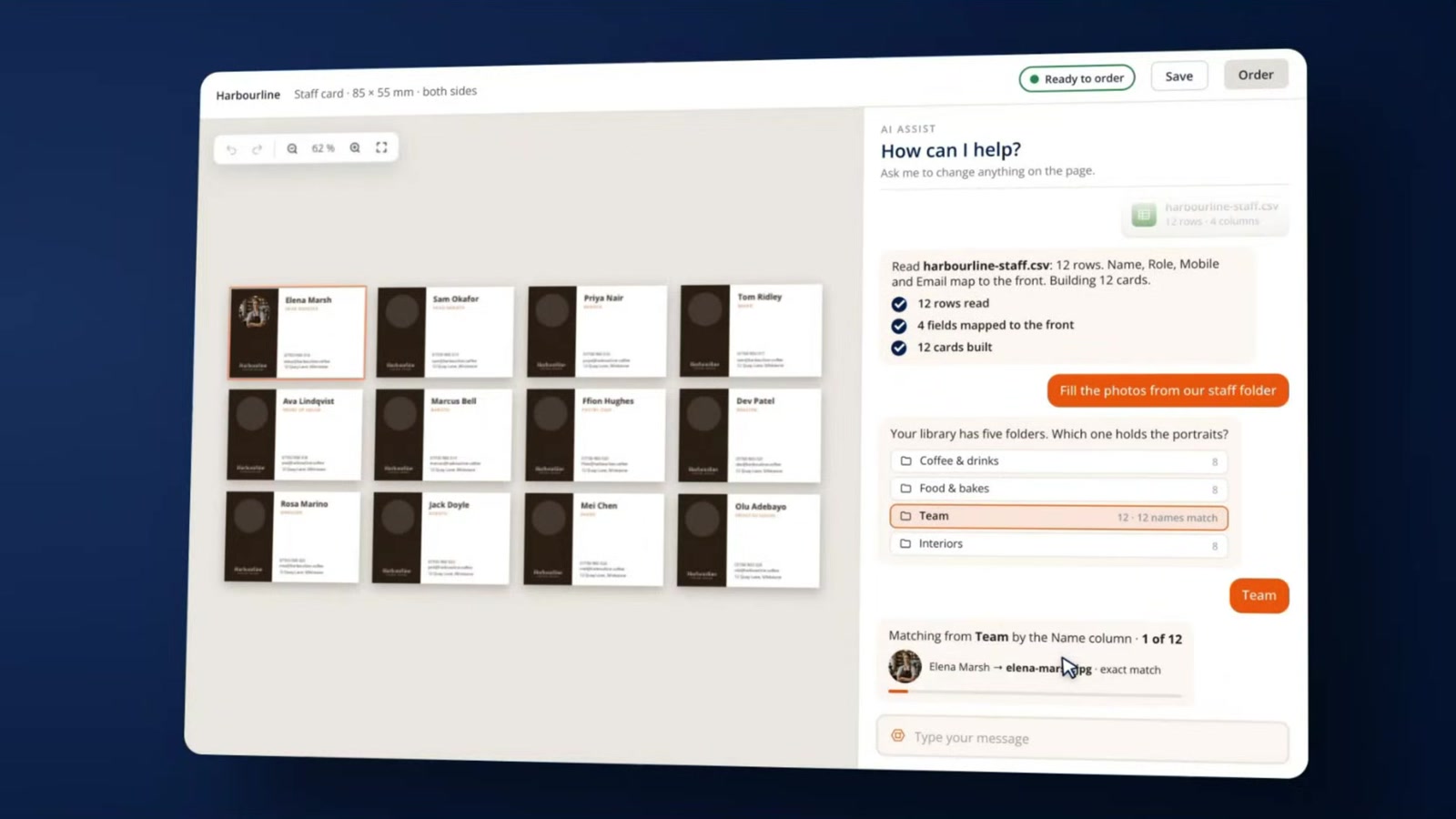
KelvinThis is a little bit different: a combination of VDP and data-driven content. A spreadsheet or CSV is brought in, and based on the number of lines it's created 12 different items. It's a business card, but it could be anything. It knows to get the images from the DAM, or an external DAM, wherever they're located, and it checks each one to make sure the text fits. Anything irregular, it highlights, so you capture the correct details.
KelvinWe can have rules for anomalies, like the pictures or the pricing being unusual, and highlight them. If we want to make changes, we can make them directly on the product, or just tell the system to. If you think we could be doing this on a mobile phone, it brings a whole other aspect to web-to-print.
KelvinThen asset management. If an image doesn't quite fit where we want it, we can ask it to amend that image, or use AI to generate one, but still with brand guardrails to make sure it's correct. Only approved fonts in certain areas; it's all managed. The system checks it's on brand, any last-minute amendments are checked again, and we get an order that's correct and can go directly to press. It manages the tone of voice too: if someone's typed something non-standard, it can highlight or correct it.
KelvinA recap of Design Assist. Conversational layout control, using natural language. Intelligent asset search, so the correct assets, data and imagery are used for the right job, locking down the brand identity. VDP and data-driven composition: personalisation is on a growth trajectory, and people want more of it in their print. Automatic typographic polish: the correct words, in the correct format, in the correct instance. Brand voice guardrails, so the wrong messaging, tone, colours and fonts aren't used. And working with AI: it can be overridden, and the guardrails can be managed and configured.
Order Assist
KelvinThen Order Assist, our third module. The problem we set out to solve is often the biggest disconnect in print today: communication. Modern corporate buyers don't speak print. They don't know paper weights, bleeds or signatures, and frankly they don't want to learn. When they're forced to navigate 300 technical dropdowns, or wait 24, 36, 48 hours on an estimator, they simply disengage. The Vpress philosophy here was: don't educate the buyer into becoming a print technician. Make the software act as a universal translator between the customer placing the order and your production team.
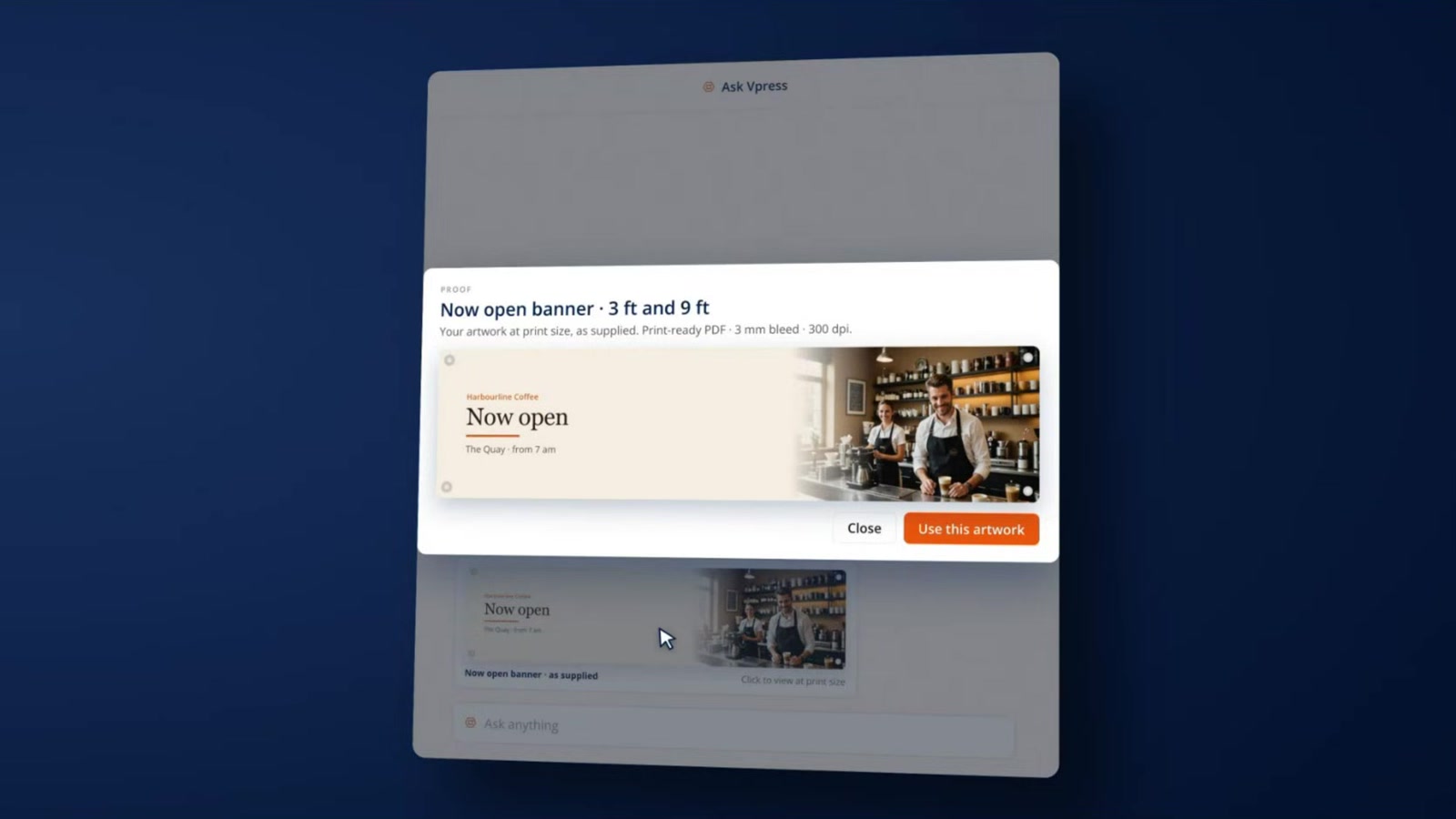
KelvinUsing natural language, the user just types what they want to order. Here's a banner. The system reads the product, gives them a visual of the banner they've uploaded, and works out the options within their guardrails. Is it for indoor? Is it for outdoor? Each can have a different substrate and different fixings. How many would you like? Then the customer reviews the order. There's been no email, and you've got something that could go directly to production.
KelvinCan we produce a newsletter? We bring in a PDF, and the system reads it using the AI engine. It works out how many pages it is and what the best run would be, linked to the profile of a product that's already in the print shop, and we can update the purchase order. Then we order some items from stock, highlighter pens, because it's not just about personalised ink on paper. It understands what the customer wants, the quantity, where it needs to go, the breakdown of the order and any additional costs. It's all about producing an order at the end of it.
KelvinThen repeat orders. On a mobile, tablet or PC, you can recall a historic order and just amend it. Maybe it's already got a cost centre assigned and you just want to change the quantity. Then the customer checks it out, for print or non-print items. And menus, which are a great example, because with menus you've got so many variables. We bring in a spreadsheet and validate that data to a much higher level: for each line we can get an image, or override it, and produce the job on screen with the correct images and pricing. Put in the delivery address, check it out, and it goes into production.
KelvinA recap of Order Assist. Natural language ordering, to bridge the communication gap between the supplier and the customer, because if the customer's happy, they'll keep coming back. Smart PDF-to-product matching, matching a customer's PDF to an existing product. Intent-led product creation. Logical steering, guiding the user to make correct, on-brand decisions. Operating within the contract and production guardrails. And data-driven content into print-ready files, saving valuable studio time. It's about automating the processes that can be automated, not removing people completely, to free up time.
Summary, and the kill switch
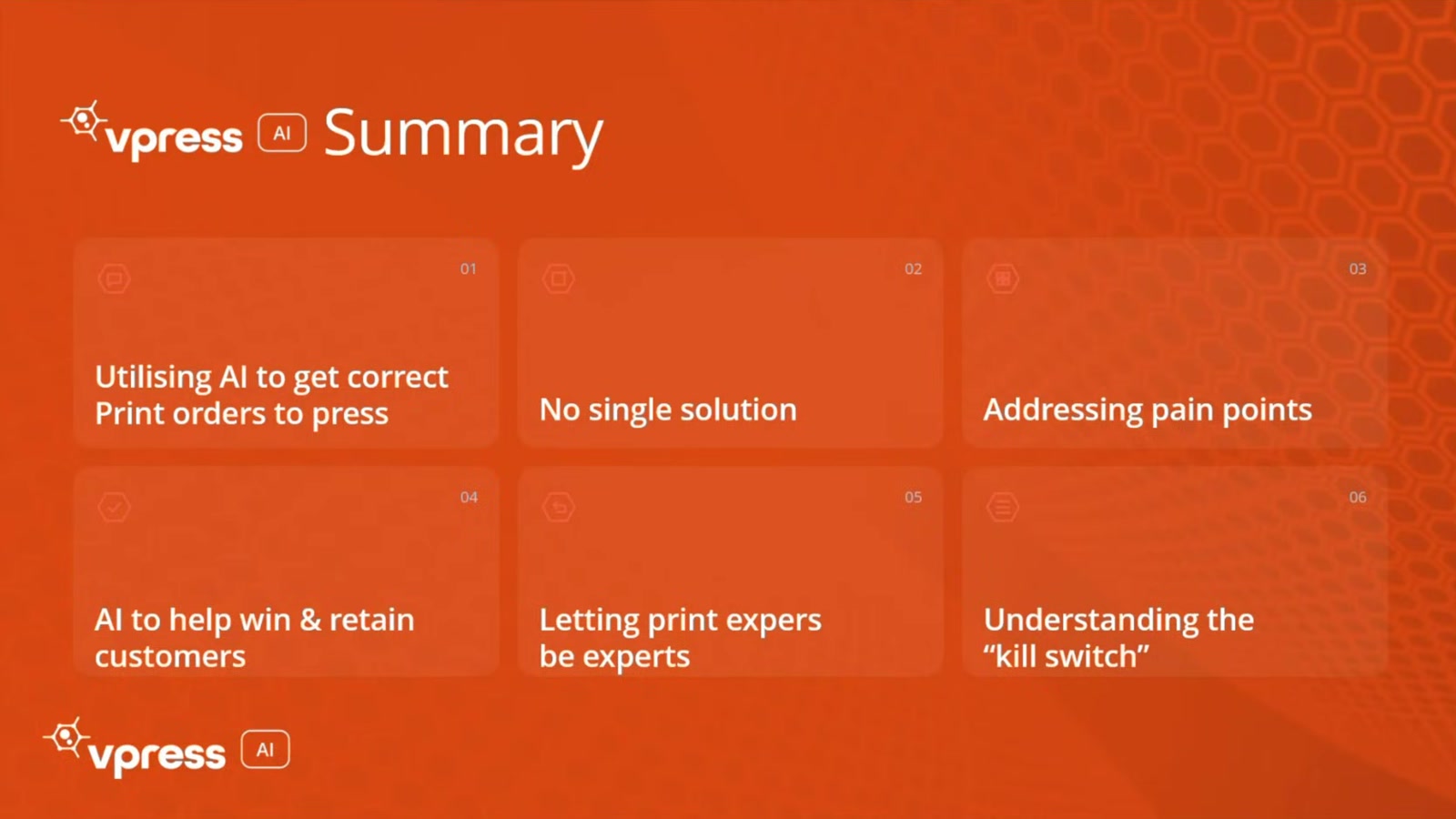
KelvinIn summary: we're using AI to get correct print orders to your presses, by engaging with the customer. We don't think there's a single solution. These are modules that by the end of the year we'll have up and running, to be used as and when needed. Use them all, absolutely fine, or pick and choose surgically. We've done this to address the pain points, because if we reduce the touch points on the jobs coming through, we're increasing your profitability. We're not putting our costs up to take a share of that.
KelvinWe're using AI to help win and retain customers. From a sales perspective, 20 minutes to set up a demo is not the end of the world, but I can now set up three demos in five minutes. I can set up a demo in front of the customer, on their brand, for them to show their stakeholders. It's hard enough to win business as it is. And it lets print experts be experts.
KelvinAnd understanding the kill switch. Many corporates now want to know there's a kill switch on the AI they're engaging with: the ability to turn AI off and not use it. Not saying they're going to, but over the last few months there's been a lot of negativity about where AI is going. So we have to have that as an option, and be able to prove it, and Vpress AI comes with that as standard.
KelvinTraditional web-to-print is a great start, and a great door opener. But getting customers to place an order, which is their expectation now, is only the start of workflow automation. Once you've got that, you can automate further and further. AI can add value by removing those bottlenecks, we support any language, and we're aiming to achieve and exceed those 10 to 30% cost savings, because that's your profit. Everything we do is about the long term.
Questions from the chat
KelvinI'm going to bring Craig in and open this up for questions. Please put them in the chat.
QuestionA client has asked if we can design a Vpress site for them if they already have an online store in the States.
KelvinAbsolutely. We support a number of printers in the US supporting European customers, and in the UK supporting US customers. We see that as a growth area, because that's what print management is: you don't have to produce it in the States and send it over here, or produce it here and send it to the States.
QuestionCan we just copy this in the UI?
KelvinIt's not so much copying. AI wouldn't be used to copy the website. You can create a storefront using AI, but it's based on Vpress technology. We wouldn't create a website for Amazon and call it Amazon 2. It's more about the storefront, and there are lots of shortcuts there if they want a B2B storefront.
CraigOn guardrails: we're not heading down the B2C route, where a user can prompt the dynamic editor to create an image that's against the brand. They have a DAM, and everything's tagged up, so it knows what each image contains. We saw a little of it in Kelvin's demo: he dropped the file in, and it pulled the images from the DAM for the products on that menu. There are standard guardrails, and you'll be able to add to them. And it will try to help you with your content, rather than generate new content. We're not trying to generate imagery that could be off-brand, but to select the pre-curated imagery that's most suitable for what you're trying to do. We're not like the people who go around saying they're AI-ready and can make all these beautiful images. That's not what brands want, and that's why they want the kill switch. They want us to stick to their brand.
KelvinWe've seen examples where people say they're using AI to ingest artwork and create templates. There are so many things wrong with that; it could be a different webinar. AI is not there yet. AI is great for some of the common functions, and we have to use it correctly.
QuestionWill there be an AI assistant in catalogue creation?
KelvinWe've kind of got that, and that's the path we're going. The catalogue normally comes from the customer, or from the products you produce. You can ingest a spreadsheet to create a range of products, and it can make sure you've got the artwork.
CraigCreating catalogues and products is something we already do with a number of customers. But AI is going to let us be much more flexible. Rather than having everything in a strict format, we can grab the data, whether via an API call or from a file, and get the AI to map it, so it knows what the SKU code is and what the description field is. Rather than one thing being wrong and it failing, we can just say: this is the data. We're hosted on AWS, so we go through Bedrock, if anyone's interested. The AI can sort that data out, maybe fill in missing fields as well, and that helps with things like Order Assist: it can analyse a brochure and say, that's 28 pages, we can saddle stitch that, because we've got the kit and the products to do it.
KelvinWe're aiming to have these AI modules up and running in test by the end of the year, so we're working really hard towards that. Customers' expectations are growing, and to meet them we pretty much have to use AI.
QuestionWould Order Assist work for customers that have preset monthly budgets, telling the user how much they have to spend over the period?
CraigAt the moment Brand Assist and Order Assist are the two primary ones, and we're getting those out in beta by the end of the year. Then we plan to bring the tone we talked about with Brand Assist into Design Assist. On Order Assist, we're trying to do more on understanding estimating. That's one of my pet projects at the moment: understanding the estimating and manufacturing process, so someone who doesn't know print can just ask.
CraigMonthly budgets aren't something we have in there now, but we need that sort of feedback, because I really do like that idea: this is the budget you've got, this is the spend. So when you say, this is the brochure I want, it says your budget gives you 4,000 of these, or in a slightly different stock that's approved with the brand, maybe four and a half thousand. That's the sort of feedback my team and I want.
KelvinWe saw a bit of that stock allocation in the repeat order.
CraigYes, we already check the stock balance. If you say, I ordered this last week, that's what I want, and we've only got 25 of the 50, it asks if you want them. That's already there and working.
KelvinJust in closing: we've been going 25 years, and we're still here. What we've always done is, we don't come up with the ideas. We speak to our customers and get them to tell us what they want. Vpress is very much customer-led, so if anyone's got ideas for doing something different, that's exactly why we want to be a different software company.
KelvinThank you, everyone, for your time today. We've got another webinar at the beginning of December, with Clarity MIS, which we'll be pushing out soon. From myself and Craig, thank you so much for joining, and enjoy the rest of your day.
Who was speaking

A web-to-print and MIS specialist with more than 25 years of delivering print systems around the world, and deep print production knowledge to go with it.

More than 25 years in ecommerce and web-to-print, putting complex systems into major print businesses and making them stick. Gave the main stage AI keynote at PRINTING United Expo 2026.