Services
PunchOut & cXML Integration for Enterprise Print Procurement
Connect Coreprint web-to-print directly to SAP Ariba, Coupa, Oracle and other eProcurement platforms with a proven PunchOut roundtrip. Your enterprise clients order print from inside their own procurement system, with every purchase governed by their approval workflows, budgets and purchase orders.
Why PunchOut Matters for Print
Corporate buyers increasingly mandate that print suppliers connect to their Procure-to-Pay platform. A proven PunchOut roundtrip is what turns that requirement from a deal-breaker into a competitive advantage.
Compliance Built In
Every order is placed inside the client's own eProcurement environment, so it automatically follows their purchasing rules, approval hierarchy and budget controls. Pre-negotiated pricing and approved products are enforced on every single purchase, eliminating non-compliant spend.
Faster, Cleaner Payment
Purchase order validation happens before the order is submitted, so every job arrives correctly authorised and signed off. That means an unimpeded payment process through the client's P2P platform, less admin chasing invoices, and a healthier cash flow.
Pioneers of the Roundtrip
Over 20 years ago the Vpress technical team carried out one of the very first PunchOut roundtrip integrations for a major global organisation. That experience now underpins successful integrations for some of the largest, most complex enterprises across the globe.
PunchOut and cXML Explained: A Plain-English Guide
If a corporate client or tender document has asked whether you support “cXML PunchOut”, this guide explains exactly what that means, how the process works from the buyer’s first click to the final purchase order, and how Coreprint from Vpress delivers it.
What Is PunchOut?
PunchOut is a standardised B2B protocol that lets a buyer working inside their company’s eProcurement system (such as SAP Ariba, Coupa or Oracle) “punch out” to an approved supplier’s storefront, configure and price their items there, then return the completed shopping cart to their own procurement system for approval and purchase.
The buyer never leaves their governed purchasing environment in any way that matters: the supplier’s storefront does the specialist work of product configuration, while the eProcurement platform keeps full control of approvals, budgets and purchase orders.
For print this matters enormously. Print products are not simple catalogue items with a fixed SKU. Business cards need personalising, brochures carry variable content, and stock levels change in real time. A static catalogue upload cannot represent that complexity, but a PunchOut connection to a specialised web-to-print platform can.
What Is cXML?
cXML (commerce eXtensible Markup Language) is the messaging standard most eProcurement platforms use to carry PunchOut conversations. It defines the secure, structured messages exchanged between the buyer’s Procure-to-Pay system and the supplier’s storefront: the initial setup request that authenticates the user, the cart data returned at checkout, and the purchase order transmitted once the order is approved.
In practice, when a tender or Pre-Qualification Questionnaire asks about “cXML PunchOut capabilities”, it is asking two things. Can your storefront hold a secure cXML conversation with our procurement platform? And can it return clean, structured order data that our finance systems can process without human intervention? Coreprint answers yes to both.
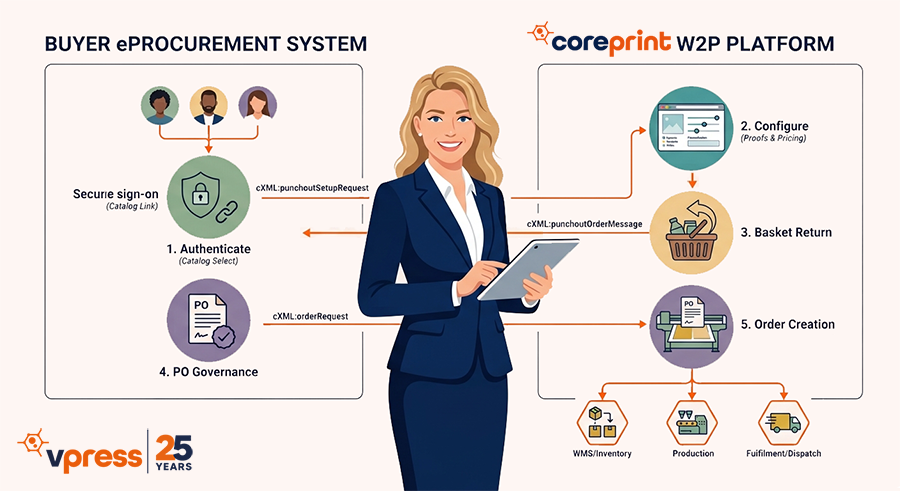
The PunchOut Roundtrip, Step by Step
- Entry: The buyer logs into their eProcurement system (SAP Ariba, Coupa, Oracle or similar) and clicks the approved print supplier’s catalogue link.
- PunchOut: A secure, encrypted cXML message authenticates the user and transfers them seamlessly to the Coreprint storefront. No separate login, no second set of credentials.
- Configuration: The buyer configures their items on the Coreprint platform: personalised templates, variable data, live stock levels and dynamic pricing, all within their corporate brand guidelines.
- Cart Return: At checkout, Coreprint packages the full configuration and pricing into structured line items and “punches back” the cart into the buyer’s shopping basket inside their eProcurement system.
- P2P Governance: The procurement platform takes back control. The order flows through the corporate approval hierarchy and budget checks, and a purchase order is raised and transmitted to the supplier.
- Order Assembly: Coreprint receives the approved purchase order and combines its data (PO number, shipping address, personnel and cost centre details) with the originating user’s exact specification from the storefront, generating the complete production order precisely to their requirements.
- Intelligent Fulfilment: Coreprint then works out what needs to be done and where. It generates guaranteed print-ready artwork, routes order information to the relevant production and fulfilment centres, and feeds warehouse management (WMS), picking and packing systems through the supplier’s automated workflow, right through to despatch.
This complete cycle, out to the storefront and back again with governance intact, is what “roundtrip” means. Plenty of storefronts can take an order; executing the full enterprise roundtrip is the technical hurdle that separates niche tools from genuine enterprise solutions. The final two steps are the layer Coreprint adds on top: not just receiving the purchase order, but converting it into finished, delivered product without manual intervention.
Which Platforms Does Coreprint Connect With?
Coreprint integrates with the major Procure-to-Pay and spend management platforms. SAP Ariba and Coupa are by far the most widely deployed and account for the majority of the enterprise estates we connect to, alongside GEP SMART, Oracle Cloud Procurement, JAGGAER, Ivalua and Zycus, plus a growing library of MIS, ERP, CRM and workflow integrations. Every corporate procurement estate is configured differently, so each connection is set up, tested and managed by the Vpress integration team rather than left to the supplier to figure out alone.
One example: when a key client of print supplier cdl moved its global purchasing onto SAP Ariba, Vpress delivered the integration that kept that relationship, and its revenue, in place. Read the cdl case study.
eProcurement Terminology Explained
The procurement software sector uses several overlapping terms depending on how much of the purchasing lifecycle a platform covers. If a client or tender document uses one of these, here is what it means and where PunchOut fits in.
eProcurement (Electronic Procurement): The broad industry term for digital purchasing platforms such as SAP Ariba and Coupa. When a buyer says “we need you to support PunchOut”, they are asking you to connect your web store to their eProcurement application, which is exactly the connection Coreprint provides for print.
P2P (Procure-to-Pay, or Purchase-to-Pay): The transactional half of procurement. It covers everything from raising a purchase requisition (PR) and issuing purchase orders (POs) to receiving goods and processing invoices with three-way matching. The PunchOut roundtrip lives in this layer: Coreprint returns the configured cart, and the P2P platform runs the approvals and raises the purchase order.
S2P (Source-to-Pay): The broader, unified lifecycle. S2P combines Source-to-Contract (S2C) activities such as spend analysis, supplier discovery, RFX tendering and contract lifecycle management with the operational P2P purchasing described above.
BSM (Business Spend Management): A wider category championed by modern SaaS vendors, unifying eProcurement with expense management, corporate card usage, treasury and third-party risk management.
Procurement Orchestration, or Intake-to-Procure (I2P): A newer layer of platforms that act as a user-friendly “front door” for employees to request purchases, automatically routing each request through security, legal, finance and ERP workflows.
Whichever label a client’s procurement estate carries, the supplier-facing requirement is usually identical: a secure cXML PunchOut roundtrip between their platform and your storefront. That is the connection Vpress has been building and managing for over 20 years.
What This Means for Print Suppliers
For a printer or print management company, PunchOut capability is increasingly the price of entry to enterprise contracts. Tier-1 corporate tenders now routinely mandate cXML PunchOut alongside requirements like ISO 27001 data security and Single Sign-On. A single technical “no” on that checklist can disqualify an otherwise winning bid.
With Coreprint, the supplier manages dynamic product templates in a single console rather than maintaining thousands of rigid SKUs. Orders arrive pre-approved and correctly purchase-ordered, artwork arrives print-ready, and payment flows through the client’s P2P platform within its standard settlement window.
What This Means for Corporate Buyers
For procurement teams, PunchOut brings the last awkward spend category under management. Print’s variable, personalised nature has historically pushed it outside the P2P system into email threads and manual quotes. A PunchOut-connected web-to-print storefront returns it to a governed, self-service channel: full contract compliance, complete spend visibility, and global brand consistency on every item ordered.
Quick Navigation
Asked for cXML PunchOut in a Tender?
Talk to the team that delivered one of the first PunchOut roundtrip integrations over 20 years ago. Book a demo and see the full Ariba, Coupa and Oracle roundtrip in action.
PunchOut & cXML Frequently Asked Questions
What is PunchOut in simple terms?
PunchOut lets someone shopping inside their company's procurement system (like SAP Ariba or Coupa) click through to a supplier's online store, build their order there, and send the finished cart back into their procurement system for approval. The buyer gets the supplier's specialist ordering tools; the company keeps full control of approvals, budgets and purchase orders.
What is cXML and how does it relate to PunchOut?
cXML (commerce eXtensible Markup Language) is the messaging standard that carries the PunchOut conversation. It defines the secure messages exchanged between the buyer's Procure-to-Pay platform and the supplier's storefront: user authentication, the returned shopping cart, and the final purchase order. When a tender asks for "cXML PunchOut", it is asking whether your storefront can hold that structured conversation end to end.
Which eProcurement platforms does Coreprint support PunchOut with?
Coreprint integrates with the leading Procure-to-Pay and spend management platforms, including SAP Ariba and Coupa (the two most widely deployed), plus GEP SMART, Oracle Cloud Procurement, JAGGAER, Ivalua and Zycus, among others. Each integration is set up, tested and managed by the Vpress technical team, who have been delivering PunchOut roundtrip integrations for over 20 years.
What does "roundtrip" mean in a PunchOut integration?
The roundtrip is the complete cycle: the buyer punches out from their procurement system to the supplier's storefront, configures and prices their items, and the completed cart is punched back into the procurement system, where approvals run and a purchase order is raised and returned to the supplier. Many storefronts can take an order; returning governed, structured cart and order data both ways is the part that enterprise procurement teams actually require.
What is the difference between P2P, S2P and eProcurement?
eProcurement is the broad term for digital purchasing platforms such as SAP Ariba and Coupa. P2P (Procure-to-Pay) is the transactional side: requisitions, purchase orders, goods receipt and invoice matching. S2P (Source-to-Pay) adds the upstream sourcing work such as tendering and contract management. Whichever term a client uses, the supplier-side requirement is usually the same: a cXML PunchOut connection between their platform and your web-to-print storefront, which is what Coreprint provides.
Why is PunchOut so important for print specifically?
Print products are not fixed-SKU catalogue items. They carry variable data, personalisation, dynamic pricing and live stock levels, which a static catalogue upload cannot represent. PunchOut lets the specialised web-to-print platform handle that complexity while the eProcurement system keeps financial control, bringing a historically unmanaged spend category fully under management.
Do I need in-house technical expertise to offer PunchOut to my clients?
No. Vpress acts as your extended technical team: we manage the digital handshakes with each client's ERP or procurement platform, carry out setup and testing, and can join pre-tender meetings and assist with technical written responses covering cXML protocols, security and compliance. Your clients get a proven integration; you stay focused on print.