5 June 2026
The Anatomy of a Perfect API Call: Mastering Enterprise Web-to-Print Connectivity
In the world of enterprise technology, the phrase “seamless integration” is thrown around so often it has almost lost its meaning. But in the print industry, an un-sanitised integration has real, physical consequences.
If a standard e-commerce site experiences a data glitch, a webpage loads slowly, or a text field formats oddly on a screen. If a Web-to-Print (W2P) integration experiences a data glitch, thousands of pounds of physical paper, ink, and machinery are wasted on a flawed, unverified production run.
Data integrity and baseline security are no longer cutting-edge features; they are the absolute minimum entry requirements for any modern enterprise platform. The true battlefield isn't just maintaining clean data, it is managing the relentless, complex, and highly bespoke requirements of the end client, and translating those demands into an elegant, repeatable reality for the supplier.
The Upstream Integration Chaos: Managing Disparate Corporate Data
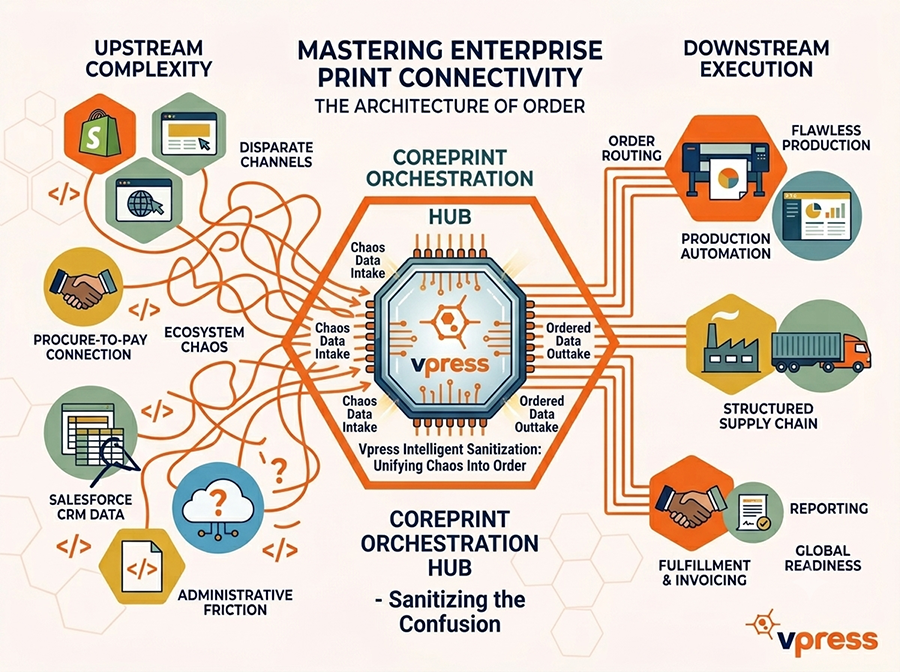
In a standard enterprise ecosystem, print requests originate from a massive variety of disconnected business applications. Corporate users expect to order their branded collateral directly from the software tools they already use every single day.
An organization might launch front-end retail storefronts via e-commerce platforms like Shopify, while their corporate procurement teams demand secure cXML Punchout catalogs linked to platforms like SAP Ariba or Coupa. Simultaneously, marketing managers require variable data printing (VDP) campaigns that are automatically driven by customer contact records held within an external CRM like Salesforce.
Managing this fragmented influx of data presents a severe technical challenge for system administrators. The difficulty lies in satisfying the intricate, bespoke procurement paths of the client while ensuring the supplier isn't buried under an avalanche of non-standard data.
The True Operational Cost of Enterprise Rebrand Spikes
When an enterprise client initiates a corporate rebrand, the strain on a print supplier's infrastructure shifts from a steady stream to a massive operational tidal wave. Consider the logistical friction of migrating a tier-1 corporate client with 7,000 distributed users onto a portal simultaneously.
On launch morning, a massive spike of concurrent users will authenticate via Single Sign-On (SSO) at the exact same moment. Without a web-to-print platform engineered for elastic cloud scale and intelligent spike management, this sudden influx of data-heavy asset renderings will cause standard applications to buckle, stall, or crash entirely.
The challenge multiplies exponentially as those 7,000 users begin configuring an entirely new, wider range of branded products - from stationery and localized marketing toolkits to complex variable data signage. Each order introduces unique distribution variables, requiring shipping to thousands of distinct regional offices, retail hubs, or remote employee addresses.
When this chaotic influx is tied to a strict, non-negotiable 3-day SLA, relying on traditional human oversight to sort, verify, and route these jobs becomes a mathematical impossibility. A single manual data-entry bottleneck or unverified address field instantly breaks the fulfillment chain, resulting in missed delivery windows, massive operational backlogs, and compromised client trust.
The Hidden Tax of Third-Party Data Sanitisation Middleware
To combat this ecosystem chaos, many technology providers rely heavily on generic, third-party low-code automation tools and middleware applications to map and clean their data. These external applications claim to sanitise incoming corporate payloads, providing a separate environment where you can manipulate data before passing it down the chain.
While this middleware approach can bridge basic connectivity gaps, it introduces a significant, ongoing financial tax and operational risk for enterprise brands. Relying on external data-cleansing services adds layer upon layer of expensive subscription costs, custom development fees, and ongoing maintenance overheads.
More importantly, it introduces an extra point of failure in the print procurement chain. When data flows through multiple third-party platforms, latency increases, security perimeters weaken, and tracking live production statuses becomes nearly impossible.
For an enterprise demanding maximum data security compliance and real-time operational visibility, relying on an fragile web of disconnected middleware tools is a costly compromise. True automation requires these data-cleansing capabilities to be baked directly into the core infrastructure of the print platform.
Enter Coreprint: The Intelligent Orchestration Hub
This is exactly why the Coreprint engine was engineered from the ground up. Coreprint does not operate as a basic e-commerce plugin; it functions as a global, cloud-based print automation engine designed to connect commercial printers and corporate brands through a unified infrastructure.
Instead of forcing you to invest in additional, expensive data-cleansing software, Coreprint bakes these capabilities directly into your web to print platform. It serves as the primary, stabilizing cog in your corporate print chain, cleanly filtering out integration noise and smoothing out systemic complexity.
How does Coreprint handle bespoke enterprise data requirements?
Coreprint utilizes a dedicated, decoupled workflow orchestration layer to rapidly map and transform quirky, non-standard legacy data formats into clean API payloads. Because this low-code data engine lives as a separate layer from the core application, bespoke client requirements can be delivered in days without bloating the main platform architecture or ever adversely affecting core system performance.
Data integrity is simply the price of admission today - the real value lies in flexibility," says Craig Smith, Product Manager at Vpress. "By baking advanced data orchestration directly into Coreprint, we absorb the complex, highly bespoke demands of the corporate client, filter out the noise, and pass only the exact, structured data required for fulfillment directly to the suppliers.
From Click to Press: The Anatomy of a Perfect Coreprint Workflow
When a corporate user interacts with a Coreprint-powered ecosystem, the journey from an initial digital click to the physical press room floor is fully automated, highly secure, and optimized for maximum speed.
Step 1: Secure Authentication and Dynamic Ingestion
The process begins the moment an enterprise user accesses the portal via Single Sign-On (SSO). Utilizing Just-In-Time (JIT) provisioning, Coreprint instantly builds the user's profile, maps their specific cost centers, and displays their pre-approved regional product catalogs.
As the user configures their print order, Coreprint can dynamically query external CRM systems like Salesforce to auto-populate exact localized addresses and variable customer metrics directly into the layout. This eliminates manual typing entirely and ensures absolute data accuracy before submission.
Step 2: Brand-Managed Asset Production and Validation
Coreprint governs asset production through two distinct, automated workstreams, ensuring total brand consistency regardless of how the user places the order.
- Primary: Granular Brand Guardianship via Managed Templates: For the vast majority of corporate procurement, users interact with class-leading template logic baked into the storefront. This allows browser-based, self-service editing for variable text fields, regional contact details, or multi-site VDP marketing campaigns. However, the core identity is fiercely protected; master brand assets such as logos, corporate typography, and structural grid alignments remain completely immutable and locked down by design.
- Secondary: Direct Artwork Ingestion and Instant Pricing: Alternatively, when a user already possesses static, finished artwork, Coreprint acts as an automated gateway. The user simply uploads their file directly into the portal, where Coreprint's native PDF Validator & Preflight Engine instantly dissects the file. It automatically counts pages, verifies image resolution integrity, analyzes color vs. black-and-white breakdown, and calculates the exact production cost on the fly - guaranteeing the file is 100% production-ready before order submission.
Step 3: Streamlined Downstream Execution
With the data sanitised and the artwork validated as 100% production-ready, Coreprint transitions from a client-facing storefront into an industrial logistics manager.
Instead of overwhelming the production floor with a chaotic mix of client-side data, Coreprint distills the transaction down to its absolute essentials. It routes only the specific, required datasets for order fulfillment, custom reporting, and invoicing directly to one or multiple production suppliers. This includes deep, matter-of-fact integration with automation tools like Enfocus Switch, allowing the entire press workflow to be completely configured based on real-time operational requirements. Coreprint simultaneously feeds complex data directly into enterprise ERPs to manage automated invoicing, stock depletion, and shipping fulfillment across global supply chains.
Elevating Your Operational Capability
Deploying a next-generation web to print platform is no longer just about offering an online print catalog. It is about establishing an intelligent, secure, and highly resilient digital infrastructure that converts manual, error-prone tasks into highly automated, high-margin workflows.
By embedding our quarter-century of technical expertise directly into the Coreprint platform, we provide your business with a robust governance shield and a 99.95% uptime guarantee. We remove the burden of managing complex, expensive third-party integration software, allowing your team to focus entirely on scaling operations, protecting brand consistency, and winning tier-1 corporate business.
Experience Coreprint in Action
Reading about seamless workflow integration is one thing, but seeing how Coreprint completely eliminates human touchpoints and automates pre-press bottlenecks across your specific setup is another. Our team doesn't just show you software features; we consult on your broader operational strategy to ensure you inherit the technical gravitas needed to win and retain Tier-1 corporate business.
Quick links: The Anatomy of a Perfect API Call: Mastering Enterprise Web-to-Print Connectivity
Table of contents
Share this article