28 May 2026
Why a "One-for-All" SaaS Solution Fails the Reality Test in Print
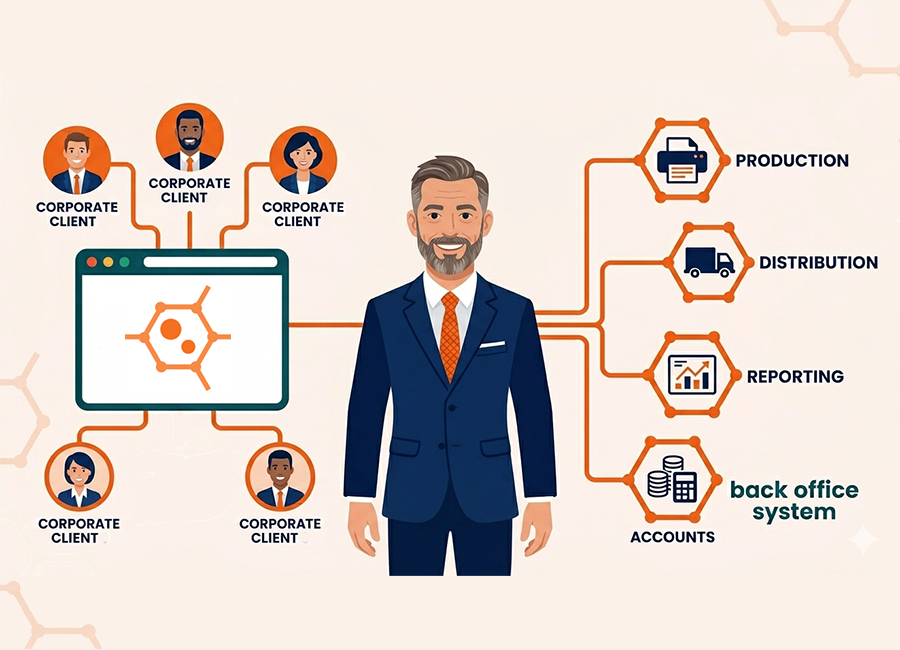
Buying into an all-in-one SaaS platform sounds like the ultimate operational shortcut for a busy printing business. The promise of a single vendor, zero external integration friction, and a unified technology stack from ordering to invoicing is incredibly compelling.
Bottom Line Up Front (BLUF): In a complex production environment, forcing customer-facing Web to Print platform and heavy back-office manufacturing into a single system introduces severe operational compromises. True efficiency is achieved by connecting specialised, best-of-breed platforms rather than settling for a generalised all-in-one solution.
The reality is that different departments on a print shop floor exist to solve fundamentally opposing problems. Forcing them into a single ecosystem inevitably starves one side of the business to feed the other.
Front-End Growth vs. Back-Office Infrastructure
At the front end, web-to-print (W2P) storefronts operate as 24/7 revenue engines. They are intensely customer-facing, requiring a friction-free user experience, dynamic real-time pricing, and rapid front-end innovation to convert corporate accounts. A commercial customer expects a seamless checkout, not a clunky interface that looks like an accounting spreadsheet.
Conversely, Management Information Systems (MIS) and Enterprise Resource Planning (ERP) platforms are built for internal operational discipline. Their job is not to attract clicks, but to manage:
- Job ticketing and complex imposition mapping.
- Inventory tracking, substrate procurement, and margin control.
- Scheduling, capacity planning, and financial reporting.
While W2P prioritises speed, flexibility, and user interaction, MIS/ERP systems prioritise structure, data integrity, and strict exception handling. You can spot an all-in-one system's compromise immediately: the storefront is usually basic and rigid, or the back-office production queue lacks depth.
The 'TV with Built-In VCR' Problem
To understand why this combined architecture slows down growth, look back at the classic 1990s television with a built-in VCR.
On paper, it was a masterpiece of convenience - one plug, one remote, no messy cables. In practice, it was a trap.
If the VCR mechanism chewed up a tape or snapped a belt, the entire unit went into the repair shop, leaving you without a television. When DVD technology emerged a few years later, you couldn't upgrade the playback component without throwing away a perfectly good screen. The integrated unit forced you to inherit the limitations of its weakest part.
This is precisely the architectural risk print businesses face with all-in-one SaaS platforms. When a single vendor’s development team has to split their focus between front-end user experience and back-office accounting, innovation crawls. You become wholly dependent on a single roadmap, unable to adopt agile front-end tools without disrupting your entire production workflow.
How does a specialised Web to Print platform improve MIS integration?
A best-of-breed strategy connects dedicated, specialised systems via modern APIs and middleware, allowing the front-end storefront and back-office MIS to exchange data seamlessly. This ensures maximum conversion rates online without compromising deep operational control or production automation on the press room floor.
The dream of the single all-in-one print software solution has always collapsed under the weight of industry reality. Print is simply too operationally complex for a single platform to excel at both high-conversion customer procurement and granular press-room scheduling without major compromise.
James Hall, Technical Director at Vpress
Moving From Compromise to Connectivity with Coreprint
This is where a quarter-century of dedicated engineering changes the equation. At Vpress, we have spent 25 years perfecting Coreprint, an enterprise-grade web-to-print infrastructure designed specifically to act as your global print automation engine, supporting advanced enterprise requirements like cXML Punchout and secure SSO for print portals. We don't try to be an MIS; instead, we provide the ultimate front-end infrastructure that integrates seamlessly with your existing back-office systems.
By deploying Coreprint alongside your preferred MIS/ERP, you eliminate the compromises of all-in-one platforms while driving a zero-touch production workflow:
- Eliminating Touchpoints: Orders captured via your print portals flow straight into your production queue, removing manual data entry and pre-press bottlenecks.
- Granular Brand Guardianship: Our native template engine transforms complex products into simple, intuitive self-service tools for variable text and image assets. Customers can personalise and proof their work instantly while master logos, layouts, and fonts remain completely immutable. Crucially, these flexible templates can be fully opened up or locked down to suit the exact corporate compliance needs of the situation.
- Built-In PDF Validation & Preflight: Every file passes through an automatic validation engine that checks resolution integrity, counts pages, and calculates colour vs. black-and-white layouts instantly. This ensures artwork is 100% production-ready before it ever reaches your back-office MIS/ERP system, stopping queue-crashing errors at the front door.
The Power of an Expert Technical Partner
Transitioning to a connected ecosystem shouldn't feel like a leap in the dark. Because Vpress operates with a 99.98% uptime global cloud footprint and an entirely UK-based development team, we provide a robust "Governance Shield" for your business.
We don't just hand over software licenses. Our team actively provides the technical, integration, and API expertise needed to sit in on complex technical bid meetings with you, helping you clear corporate procurement hurdles and secure lucrative Tier-1 contracts.
See Coreprint in Action
Reading about seamless workflow integration is one thing, but seeing how Coreprint completely eliminates human touchpoints and automates pre-press bottlenecks across your specific setup is another. Our team doesn't just show you software features; we consult on your broader operational strategy to ensure you inherit the technical gravitas needed to win and retain Tier-1 corporate business.
Quick links: Why a "One-for-All" SaaS Solution Fails the Reality Test in Print
Table of contents
Share this article