18 December 2025
Web-to-Print Software: 5 Risks of Product Personalisation Integration
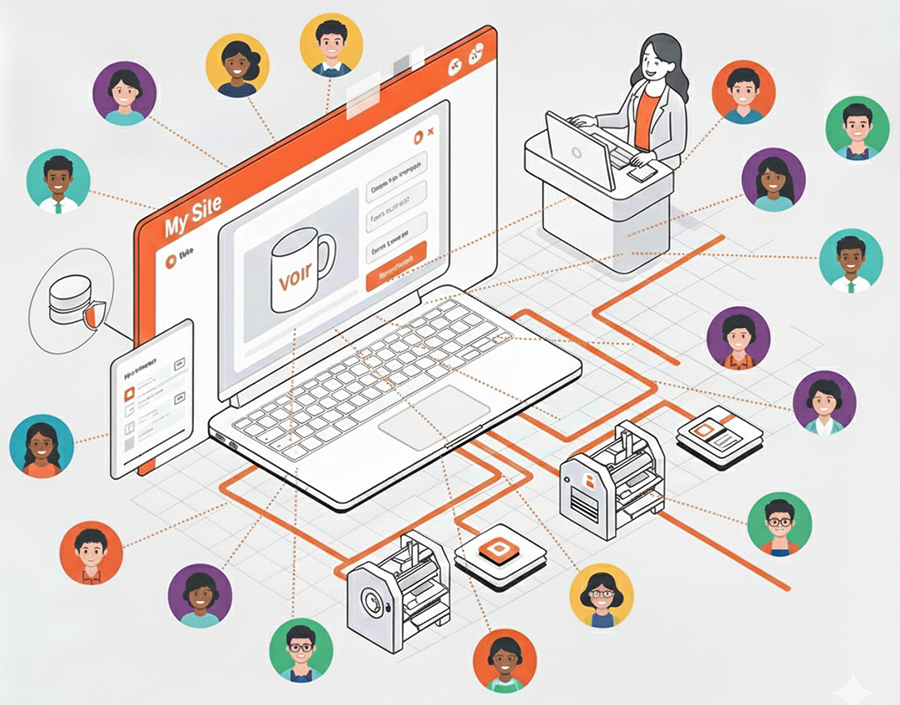
In the current e-commerce landscape, standard "off-the-shelf" products are no longer enough to guarantee customer loyalty. Whether you are running a Shopify store, a WordPress site, or a bespoke e-commerce platform, the demand for product personalisation is skyrocketing. Customers want to put their stamp on what they buy, and businesses that offer this "sticky" experience see higher engagement and better margins.
However, for many business owners and developers, the path to finding the right web-to-print software to power this experience is paved with expensive mistakes.
A search for "web-to-print solutions" yields hundreds of results. On the surface, they all look similar: a design tool pops up, the customer personalises a template, and an order is placed. But beneath that surface, many web-to-print platforms suffer from fundamental architectural flaws that can damage your brand and throttle your growth.
Before you choose a technology partner to embed into your website, ensure you aren't walking into one of these five common traps.
1. The Fulfillment Trap: Losing Your Customer
One of the most common models in the personalisation market is the "service bureau" approach. These providers offer a plugin that looks like it belongs to you, but they are essentially embedding their shop inside yours.
The danger here is twofold. First, they handle the fulfillment, often giving you a small commission while they take the lion's share of the margin. You lose control over quality, shipping times, and packaging.
Second, and more critically, they capture your customer data. Because they are fulfilling the order, they have the contact details and buying habits of your users. You are effectively handing your hard-earned traffic to a third party who can market directly to them in the future, cutting you out of the loop entirely.
The Fix: Look for technology that is purely software-based, allowing you to route orders to your own production facility or your own trusted network of suppliers.
2. The Shiny Front-End / Broken Back-End
It is easy to be seduced by a slick, shiny user interface. Many plugins offer a decent design experience for the consumer, often relying on standard frameworks like Shopify or WooCommerce to handle the transaction.
However, a "shiny front end" is useless if the back end relies on manual processes. If your website is successful, you need to plan for volume. If every order requires a staff member to manually download a file, check it, rename it, and move it to a hot folder, you have created a bottleneck.
The challenge with most web-to-print tools isn't the user interface; it's the data. If the software doesn't produce a PDF that is technically perfect for a specific press, the cost of manual intervention will quickly eat every penny of your profit margin.
Frank Romano, Professor Emeritus, Rochester Institute of Technology (RIT), and world-renowned printing industry expert.
As soon as order volumes spike, this manual download process fails. You will be left with a backlog of orders, late deliveries, and burned-out staff.
The Fix: True scalability requires workflow automation. The technology must not only capture the design but also automate the transition from "checkout" to "production queue" without human intervention.
3. The 'Not Production-Ready' File
There is a massive difference between a file that looks good on a smartphone screen and a file that is ready for a professional printing press.
Many lightweight personalisation plugins generate basic PDF or image outputs that lack professional print specifications. They may be RGB instead of CMYK, lack bleed areas, or have insufficient resolution.
If you cannot 100% rely on the integrity of the output file, you are putting your production process at risk. You face two expensive outcomes:
The Cost of Correction: Your pre-press team has to fix every file manually.
The Cost of Reputation: You print the file as-is, the customer receives a poor-quality product, and you face refunds and bad reviews.
The Fix: Ensure the software generates production-ready files (e.g. high-res PDFs with variable data support) that are strictly validated before they ever reach your production floor.
4. The Integration Nightmare
You want a professional tool embedded in your site, but you don't want to burn through your budget paying developers to reinvent the wheel.
Some solutions require complex server-side installations, messy third-party licensing, or even a rewrite of your existing system architecture. This leads to weeks of painful testing, deployment issues, and ongoing maintenance headaches.
The Fix: You need a solution designed for seamless integration. Whether via API or a pre-built plugin, the technology should feel like it has always been there, requiring minimal developer time to deploy and zero disruption to your existing hosting environment.
5. The Disjointed User Journey (The 'Pop-Out')
User Experience (UX) is the currency of e-commerce. A major flaw in many legacy personalisation tools is the "iframe" or "pop-out" method, where the user clicks "personalise" and is visibly taken to a different URL or a jarringly different interface to design their product, only to be thrown back to the cart afterward.
This breaks the trust chain. The customer feels like they have left your secure environment. This disjointed experience increases cart abandonment rates as users lose confidence in the security and professional nature of the site.
In e-commerce, friction is the ultimate conversion killer. If a customer feels they are being handed off to a third-party tool that doesn't look or feel like your brand, they don't see 'personalisation' - they see a security risk. A seamless, embedded experience is no longer a luxury; it’s a requirement for trust.
Nielsen Norman Group (UX Research Insights)
The Fix: The editor must be fully embeddable. It should adopt your CSS, your branding, and keep the user firmly within your domain throughout the entire journey.
Conclusion: Solving the Puzzle with Vpress Embedded Tech
Finding a web-to-print solution that balances a great user experience with professional-grade production integrity is difficult. Most software providers are either good at the "web" part (pretty interfaces) or the "print" part (production files) - rarely both.
The most successful print-on-demand businesses are those that own their technology stack and their data. By embedding personalisation directly into your site rather than outsourcing the whole shop, you maintain the relationship with the customer - which is the most valuable asset you have.
Jennifer Matt, President of WhatTheyThink.
At Vpress, we built our Embedded Tech specifically to solve these five challenges, utilizing 25 years of hard-learned industry experience. We don't want your customers or your fulfillment margin; we simply provide the world-class web-to-print platform to power your growth.
Our technology allows you to:
- Own the Workflow: Connect customer designs directly to your production workflow (or your suppliers) via our integrated web-to-print solution for fully automated fulfillment.
- Guarantee Quality: Every design becomes a production-ready file, eliminating manual checks and the "hidden costs" of pre-press errors.
- Integrate Effortlessly: With developer-friendly APIs, comprehensive documentation, and a dedicated Shopify plugin, you can be up and running fast.
- Keep Your Customers: Our editor embeds seamlessly into your site, offering a white-label experience that keeps the spotlight on your brand, not ours.
Frequently Asked Questions
What is the difference between product personalisation and web-to-print?
Product personalisation is the user-facing experience where a customer customises an item (like adding text to a mug or a name to a business card). Web-to-print is the professional technology that powers that experience and, crucially, converts that design into a production-ready file for a printing press. While many tools offer personalisation, a true web-to-print platform ensures the final output is high-resolution, accurately coloured, and ready for manufacture.
Learn more
Can I integrate web-to-print software into an existing Shopify or similar CMS site?
Yes. Modern web-to-print integration is designed to work with leading e-commerce frameworks. You can embed a professional editor directly into your product pages via an API or dedicated plugin. This allows you to maintain your brand’s look and feel while leveraging a powerful back-end engine to handle complex artwork generation and workflow automation.
Why is "production-ready" output important for my e-commerce store?
If your software only generates low-resolution images or standard PDFs, your production team will have to manually fix every order before it can be printed. This creates a massive bottleneck as you scale. Professional web-to-print software generates "production-ready" files that include bleed, CMYK colour profiles, and high-resolution vectors, allowing for automated fulfillment without human intervention.
Quick links: Web-to-Print Software: 5 Risks of Product Personalisation Integration
Table of contents
Share this article