20 March 2026
The Print Industry’s Green Revolution: From ‘Scope 3’ Challenges to Tech-Led Solutions
The commercial print industry is currently navigating one of its most significant structural shifts since the dawn of the digital age. It is no longer enough to be fast and cost-effective; the modern Print Service Provider (PSP) must now be transparently sustainable. With the arrival of stricter ESG (Environmental, Social, and Governance) reporting mandates and the looming pressure of ‘Scope 3’ supply chain audits, corporate brands are looking at their B2B print procurement through a new lens.
They are no longer just asking about price; they are asking: “How much of this is going to waste? Can we prove the carbon cost of this order? And is our supply chain resilient enough to survive a carbon tax?”
The Challenge: The ‘Invisible’ Waste of the Analog Model
For decades, the print industry operated on a ‘Push’ model-producing large quantities of static assets to achieve a lower unit cost. According to research from Keypoint Intelligence, up to 30% of traditionally printed marketing materials are discarded due to obsolescence before they ever reach a customer - whether caused by branding changes, outdated information, or simply over-estimating demand. This isn't just a financial loss; it’s a carbon catastrophe.
Furthermore, the ‘Data Gap’ has long hindered the industry. Without integrated web-to-print software, calculating the true footprint of a global print campaign-including substrates, production energy, and the logistics of ‘Category 9’ downstream transport-was historically impossible for most procurement teams.
The Offshoring Illusion: The Hidden Cost of ‘Cheap’ Print
A common procurement strategy has been to offshore massive print runs to regions with lower labor costs. While saving 15% on a unit price seems like a win on a spreadsheet, it is often a false economy in the era of Net Zero.
Paper is heavy. Transporting pallets of printed material across the globe via sea freight forces brands to order months in advance, leading to massive over-ordering to justify the shipping costs. Data from the MIT Center for Transportation & Logistics indicates that logistics can account for up to 40% of a printed product's total carbon footprint, with air freight significantly multiplying that impact compared to localised production.
Manufacturing in regions with less stringent environmental regulations also risks the use of non-certified paper stocks and carbon-intensive energy grids, leaving the brand exposed during a sustainability audit.
As Charles Jarrold, CEO of the BPIF, notes:
Sustainability has moved from a 'nice to have' to a core business metric. Technology that automates this reporting is the next frontier for the industry.
The Mitigation: How Coreprint Solves the Sustainability Gap
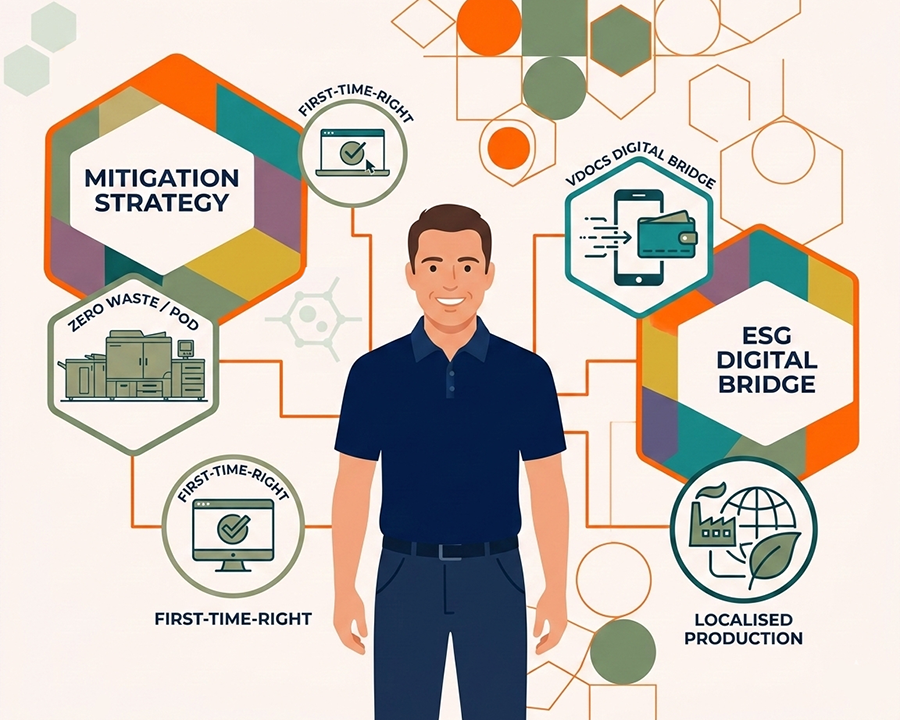
At Vpress, we believe the most sustainable piece of print is the one that is produced with zero errors and zero waste. Our approach to environmental mitigation is built on shifting the industry from a 'Push' to a 'Pull' model through our Coreprint web-to-print platform.
1. Moving to a ‘Zero-Waste’ Production Cycle
By utilising a dynamic web-to-print storefront, brands can finally eliminate the 'Minimum Order Quantity' (MOQ) trap. Coreprint enables a 'Right-Sized' production workflow where users only order exactly what is needed for a specific campaign or location. By moving to a 100% Print-on-Demand (PoD) model, we eliminate the energy-hungry warehouses and the 'stale stock' that traditionally accounts for a third of all print waste.
2. Digital Decarbonisation and the ‘Hybrid’ Bridge
To achieve true sustainability, we must move beyond the 'print vs. digital' binary and instead focus on Digital Decarbonisation. This involves selecting the medium with the lowest environmental impact for its specific purpose. We facilitate this through two distinct technological pathways:
-
The Vdocs 'Zero-Paper' Ecosystem
For high-frequency, short-lived interactions - such as networking or event access - Vdocs allows brands to bypass the press entirely. This digital-first approach works in two primary ways:
- Direct Data Exchange: A digital business card or vCard stored in a mobile wallet that instantly passes contact data or credentials to another person’s phone upon being scanned.
- Instant Document Access: A secure digital pass that serves as a direct gateway to a personalised online document, hosted in the cloud and accessible instantly without a single gram of paper being produced.
By utilising Vdocs for these high-turnover assets, brands eliminate the 'last-mile' delivery logistics - the most carbon-intensive segment of the supply chain - and save thousands of tonnes in paper production.
-
The Hybrid Bridge: Physical Print with Digital Depth
The second pathway is the Hybrid Model, where physical print acts as a high-impact 'anchor' for deep digital content. By incorporating dynamic QR codes into printed documents, brands can provide a gateway to supplementary online manuals, real-time pricing updates, or immersive video content.
This hybrid approach allows the physical piece to remain 'evergreen' and concise, significantly reducing the page count and frequency of reprints. As we explored in our deep dive into the power of QR codes, this connection is the crucial link in bridging the digital-physical divide. It allows for a tactile brand experience while maintaining a minimal, data-driven environmental footprint.
3. ‘First-Time-Right’ Logic: The End of the Reprint Cycle
One of the most overlooked sources of waste is the ‘reprint’ caused by user error. Our web2print solutions incorporate real-time file checking and production-grade previews directly within the browser.
Crucially, we incorporate onscreen editable proofs and digital approval workflows. This empowers the people who actually understand the content - the marketing managers, franchise owners, or subject matter experts - to create, edit, and approve the document in a live environment. By ensuring that the 'right eyes' sign off on a digital proof before a single drop of ink is spent, we eliminate the 'game of telephone' between the client and the press. If a user uploads a low-resolution image or misses a brand guideline, the platform flags it instantly. This ensures that paper, ink, and energy are never wasted on a job destined for the bin.
Localised Production and MIS Intelligence
You cannot manage what you do not measure. Through deep-tier web-to-print MIS integration, Vpress acts as a data engine for the ESG audit. We help record every detail-from substrate types to production locations-allowing the brand to see exactly where their carbon is being spent.
This is further supported by our platform's ability to facilitate Distributed Production. By routing jobs to a vetted Print Service Provider closest, we significantly slash the emissions associated with shipping. You 'Print Locally' to save globally.
Coreprint even supports the ablility to literally print locally, so they can download the print ready file and print it on their desktop device - the ultimate localised print!
Walking the Walk: Our Own Green Commitment
We believe that as a technology provider, our own house must be in order. For over a decade, the Vpress headquarters has been supplied by 100% green energy. Our SaaS infrastructure is built on high-efficiency cloud architecture, ensuring that the digital tools our clients use to save the planet aren't contributing to the problem through hidden server-side emissions.
The High Note: A Future Built on Adaptation
The print industry is not a relic of the past; it is an evolving ecosystem. As the organisation Two Sides reminds us:
The paper industry is one of the few that is genuinely and inherently sustainable. The key for modern brands is to use paper responsibly-minimising waste through on-demand technology.
At Vpress, we are proud to be the bridge between the heritage of print and the necessity of a digital, sustainable future. By combining the power of the physical medium with the precision of an enterprise web-to-print platform, we are helping the industry lead the way toward a Net Zero world.
Stop Guesstimating Your Carbon Footprint.
Most organisations are losing 30% of their print budget - and their carbon credit - to avoidable waste and 'just-in-case' warehousing. It’s time to move from a legacy 'Push' model to a high-efficiency, 'First-Time-Right' digital ecosystem.
Ready to automate your ESG reporting and kill the reprint cycle?
Frequently Asked Questions
How does Web-to-Print actually provide data for Scope 3 emissions reporting?
Most sustainability gaps exist because print is ordered via fragmented emails and spreadsheets. Our platform acts as a centralised "data engine" through deep MIS integration. Every order is logged with its specific production location, substrate type, and weight. This allows procurement teams to export "audit-ready" reports that quantify the environmental impact of their entire print supply chain, making ESG compliance a push-button process.
Is localised production via Web-to-Print more expensive than offshoring?
On a "unit price" basis, a far-flung offshore printer may look cheaper. However, when you factor in the Total Cost of Ownership (TCO) - including international freight, import tariffs, and the 20-30% waste caused by ordering bulk stock that becomes obsolete - localised production is often more cost-effective. Furthermore, printing closer to the delivery point slashes "Category 9" emissions, which protects your brand from future carbon taxes and delivery delays.
When should I choose Vdocs over a traditional printed document?
The rule of thumb is Frequency vs. Longevity. If a document has a short lifespan or high update frequency (like a weekly price list, an event ticket, or a temporary internal manual), Vdocs is the superior environmental choice. It removes the carbon cost of paper, ink, and physical delivery. For high-impact brand "anchors," we recommend a hybrid approach: a concise, high-quality physical piece featuring a QR code that bridges to the live, digital version in Vdocs.
How do 'editable proofs' prevent physical print waste?
In traditional workflows, the person who knows the content (the client) and the person who sets the file (the printer) are disconnected, leading to the "reprint cycle" when errors are found after production. By using Coreprint’s onscreen editable proofs, the subject matter expert manages the content in real-time. The platform's 'First-Time-Right' logic flags low-resolution images or brand violations before the job is submitted, ensuring that energy and paper are never wasted on a job destined for the bin.
Can this sustainability data be integrated into our existing ERP or sustainability dashboard?
Yes. Through our robust API and MIS integration capabilities, the data captured within the Vpress ecosystem can be fed directly into your corporate ERP or third-party sustainability software. This eliminates manual data entry and ensures your print procurement impact is represented accurately in your total corporate environmental reporting.
Quick links: The Print Industry’s Green Revolution: From ‘Scope 3’ Challenges to Tech-Led Solutions
Table of contents
Share this article